You’re preparing for an investor meeting. You know your deck needs to look professional. And you’re wondering: how much should I actually pay for this?
The honest answer is: it depends on what you need. Design-only for an existing deck costs far less than a full rewrite from scratch. A pre-seed founder needs something different from a Series B company. And “affordable” means different things to different budgets.
This guide breaks down exactly what pitch deck design costs at every price point — what you get, what you don’t, and how to decide which option makes sense for your situation.
The Short Answer: Pitch Deck Design Cost by Option
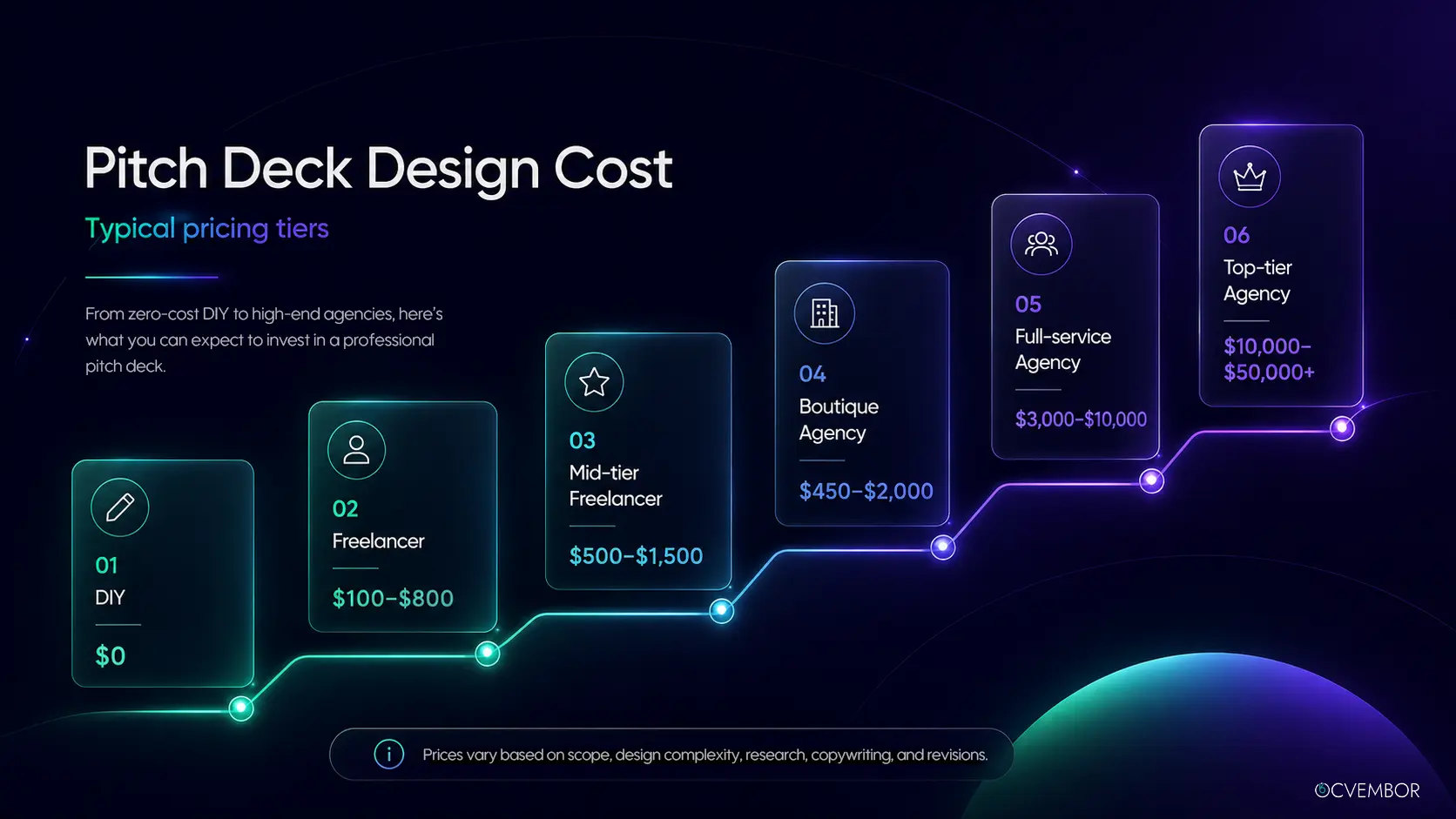
Option 1: DIY — $0
What you get: Full control, zero cost, and a deck that looks like you made it yourself at midnight.
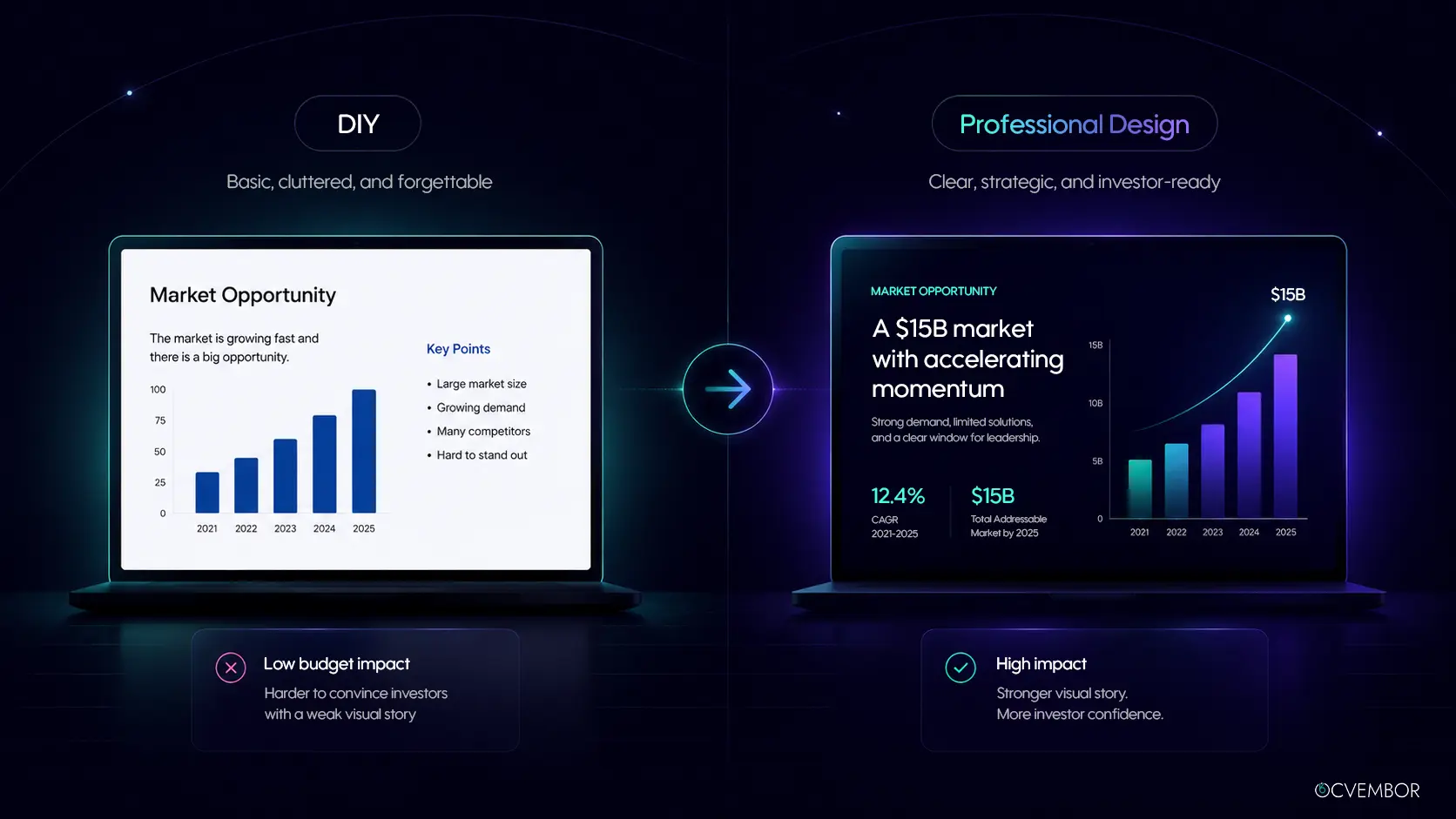
Canva has improved significantly. If you have a good eye for design, a solid grasp of your narrative, and time to spare, a Canva deck is not automatically a bad deck. The problem is that most founders don’t have all three of those things at once.
The real cost of DIY is hidden: it’s the 20 hours you spend on formatting instead of talking to customers, and the “pretty good” deck that gets passed over because it looks like ten others the investor saw that week.
DIY makes sense if you’re at the idea stage, testing your pitch before your first few conversations, or genuinely have design skills.
Option 2: Cheap Freelancer — $100–$800
What you get: A visual makeover of your existing slides.
Platforms like Fiverr have thousands of designers who will re-style your deck for a few hundred dollars. At this price, you are paying for graphic execution only. You bring the content, structure, and story — they make it look cleaner.
The catch: Quality varies wildly. A $200 Fiverr designer might deliver excellent work. Or you might get back something that looks like a corporate PowerPoint from 2015. Without a strong portfolio, a contract, and clear briefing, it’s a gamble.
This option works well for a quick visual refresh if you already have a strong narrative and just need the slides to look polished.
Option 3: Mid-Tier Freelancer — $500–$1,500
What you get: A more experienced designer who can improve layout, hierarchy, and visual consistency. Some may offer light feedback on structure.
At this range, you’re getting a professional who has done this before. They’ll fix the obvious problems: inconsistent fonts, poorly laid-out data slides, clashing colors.
What you usually won’t get at this price: strategic feedback on your narrative, investor-specific knowledge of what slides to include, or content writing.
Search Upwork for designers with pitch deck portfolios and $50–80/hour rates. Look for people with reviews mentioning funding rounds, not just “nice design.”
Option 4: Boutique Agency — $450–$2,000
What you get: A small team that specialises in pitch deck and presentation design. Clean deliverables, clear process, faster turnaround than larger agencies.
This is where you start getting real accountability. A boutique agency has a process: they’ll ask about your business, your audience, your funding stage. They’ll structure the deck before touching design.
Ocvembor’s pitch deck design services start at $450 for a visual refresh and go to $1,200 for a complete transformation — including narrative structure, data visualisation, and full custom design. Most founders at seed or Series A land in the $750 range.
Why is this cheaper than larger agencies? Because we’re a small, focused team. You work directly with the designer. There’s no account manager markup, no layers of approval. You get fast turnaround (3–4 business days) and direct communication.
This is the range where you get the best value if you’re raising under $5M and need a deck that looks like you paid significantly more.
Option 5: Full-Service Agency — $3,000–$10,000
What you get: Strategy, writing, and design packaged together.
Agencies like Slidebean and Whitepage operate at this level. You’re not just paying for slides — you’re paying for an analyst to interview you, a writer to craft your narrative, and a designer to bring it to life. Some include financial model review.
If you struggle to articulate your story clearly, can’t write compelling slide headlines, or are raising a significant amount from institutional investors, this investment can make sense. The bet is that a $5,000 deck that helps you close a $2M round pays for itself 400 times over.
The main limitation: the process is slower (2–4 weeks for a full engagement) and the economics only make sense at certain raise sizes.
Option 6: Premium and Enterprise — $10,000–$50,000+
What you get: The best available talent, often with Silicon Valley network access, custom illustration, and sometimes percentage-of-raise arrangements.
This end of the market exists for a reason. Late-stage companies with complex stories, M&A materials, or large LP fund presentations sometimes need this level of craft and confidentiality.
For most early-stage founders, this is simply too expensive relative to the upside. A $15,000 deck does not guarantee better investor meetings than a $1,200 one.
What Actually Drives Pitch Deck Design Cost
Understanding what moves the price helps you figure out where to invest and where to cut.
1. Design only vs. design + writing
Design-only work (making your existing slides look better) is consistently cheaper. Adding content strategy and writing — which involves understanding your business, restructuring your narrative, and writing investor-grade headlines — roughly doubles or triples the cost.
This is worth knowing because most founders underestimate how much of the work is strategic, not just visual.
2. Number of slides
A 10-slide deck takes less time than a 25-slide deck. Standard investor pitch decks run 12–18 slides. If you’re being quoted per-slide, $25–$60 per slide is a reasonable range for professional design.
3. Turnaround time
Rush delivery (under 48 hours) typically adds 30–50% to the cost. If you have flexibility on timing, you’ll pay less.
4. Level of customisation
Generic visual treatments with your brand colours applied cost less than fully custom illustration, original infographics, or complex data visualisations. Both can look excellent — it depends on your brand and how much originality your deck needs.
5. Revisions included
Agencies that include unlimited revisions are pricing that risk into the base fee. Budget services often limit you to 1–2 rounds, which can create stress if the first draft misses the mark.
What You Should Pay Based on Your Stage
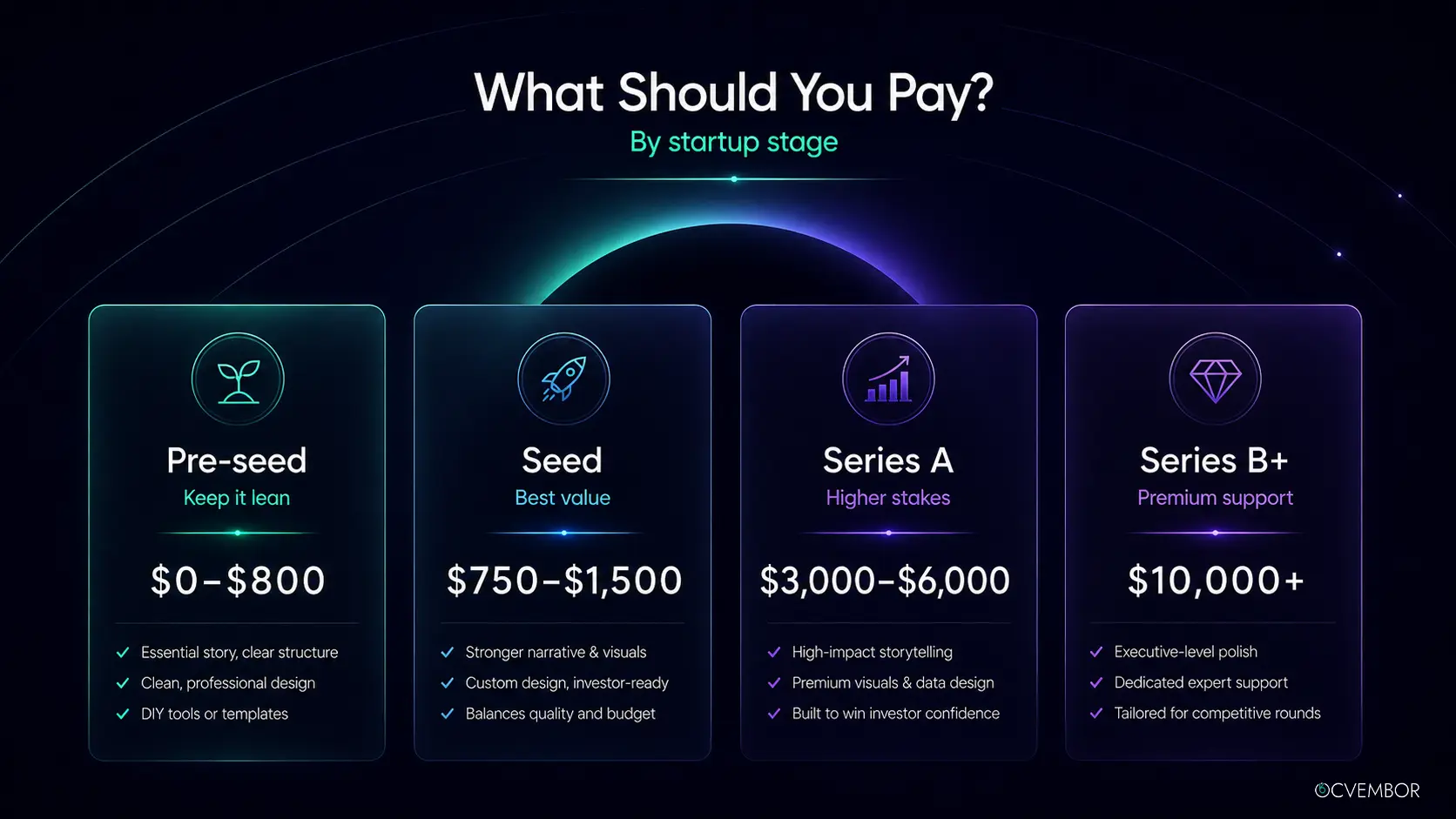
Pre-seed / idea stage
Spend as little as possible. Your deck will change significantly based on investor feedback. A mid-tier freelancer at $500–800 or a boutique agency refresh at $450 is sensible. Don’t spend $5,000 on a deck for a story that isn’t fully formed yet.
Seed round ($500K–$3M)
This is where quality starts to matter. Investors at seed stage are evaluating you heavily on professionalism and clarity. A boutique agency in the $750–$1,500 range gives you a deck that looks like it belongs in the room. This is Ocvembor’s most common engagement.
Series A ($3M–$15M)
The stakes are higher and the competition is stiffer. A full-service agency at $3,000–$6,000 may be worth it, especially if you’re targeting institutional VCs who see hundreds of decks per month.
Series B and beyond
At this stage, you likely have design resources internally or a PR/comms team. Enterprise agencies or top-tier boutiques make sense here.
Pitch Deck Design Cost: The Real Calculation
The most useful frame is not “how much does this cost” but “what is the cost of a bad deck?”
If you’re raising $1M and a weak deck reduces your chances by 10%, that’s a $100,000 expected loss. Against that, $750 for a professionally designed deck is not an expense — it’s a bet with very favourable odds.
That said, design alone doesn’t raise money. The most important thing is your story: the problem you’re solving, the traction you’ve built, and the team behind it. A great deck can’t compensate for a weak business. But a bad deck can absolutely cost you conversations with investors who would have funded you.
The goal is the minimum spend that makes your story land as well as it deserves.
Red Flags When Hiring a Pitch Deck Designer
They can’t show pitch-specific work.
General graphic design skills are not the same as pitch deck skills. Ask to see decks they’ve designed for other founders, not just pretty presentations.
They deliver a static PDF with no editable source file.
You will need to update your deck — new numbers, a different market slide, a revised ask. If the final deliverable is a locked PDF, you’re dependent on the designer for every future change. Always confirm upfront that you’ll receive the editable PowerPoint, Keynote, or Google Slides file.
No process or timeline.
A professional agency has a clear workflow. Discovery, structure, design, review. If they can’t explain how it works, the output will reflect that.
Summary: How to Choose
If you have under $500 and need to move quickly, a mid-tier freelancer with pitch experience gets you where you need to be.
If you’re at seed or Series A and want professional quality at an honest price, a boutique agency in the $450–$1,500 range is the right call. The deck will look like it cost three times as much.
If your story is complex, your raise is large, or you need someone to help you write and structure the content from scratch, budget $3,000–$6,000 for a full-service engagement.
What you shouldn’t do is spend $15,000+ at early stage or treat DIY as “good enough” when you’re walking into a meeting with investors who have seen tens of thousands of decks.
Work With Ocvembor
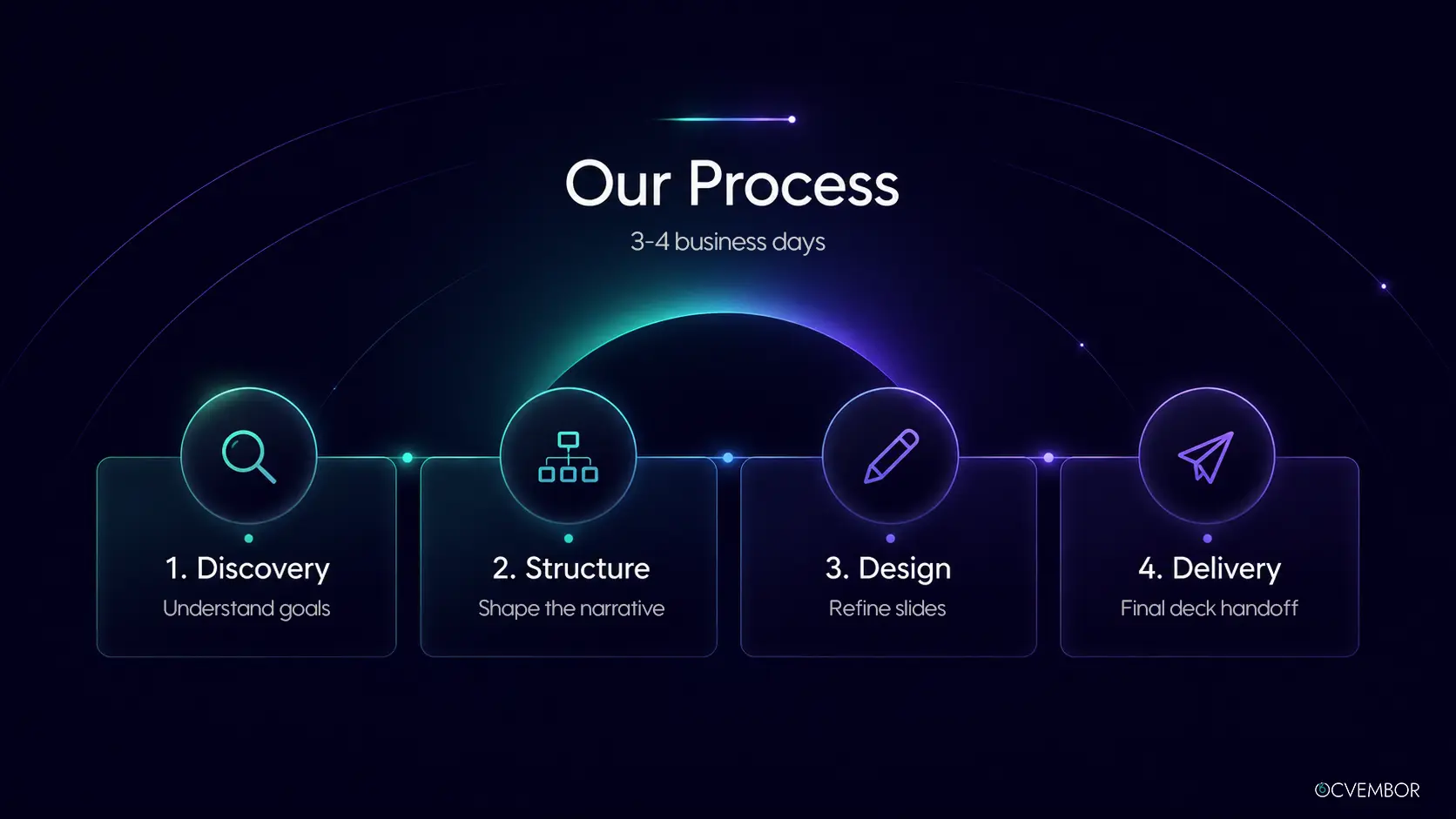
We design pitch decks for startups at seed and Series A. Our packages start at $450 and most projects deliver in 3–4 business days.
We’re a small team, which means you work directly with the designer — not through layers of account management. We structure the story before we design a single slide, and we don’t charge by the revision.
Have a question about what your specific project might cost? Send us a message at contact@ocvembor.com and we’ll give you a straight answer.